
Dodgers vs Brewers: What Went Wrong for Los Angeles and What Happens Next?
- Sports
 Lisa Martin
- 7 minutes read

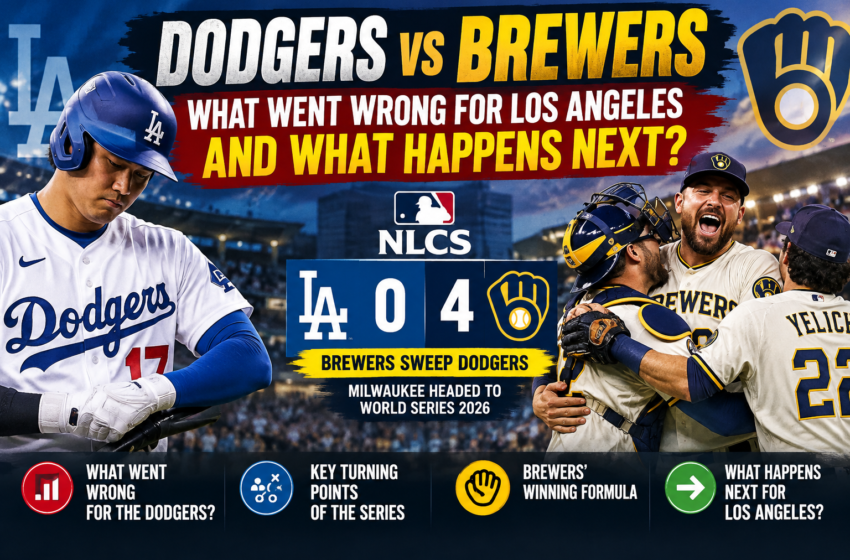
Dodgers vs Brewers: What went wrong for Los Angeles and what happens next?
Dodgers vs Brewers: The Los Angeles Dodgers’ bid for a historic third straight World Series title is over. Milwaukee completed a stunning four-game sweep in the 2026 National League Championship Series, winning Game 4 by a 6-4 score at Dodger Stadium on Thursday. For a Dodgers team built to dominate October, the result raises a bigger question than the final score: what actually went wrong for Los Angeles?
The answer was not one bad inning or one unlucky bounce. The Brewers consistently found ways to win the important moments, while the Dodgers struggled to turn opportunities into runs. Milwaukee now moves on to the World Series for the first time since 1982, while Los Angeles begins an offseason filled with questions about its offense, pitching depth and postseason execution.
What Went Wrong for the Dodgers?
The biggest problem was offensive inconsistency. Los Angeles managed only five hits in Game 3 and was held without a home run for three straight postseason games before Shohei Ohtani finally connected in Game 4. That was especially surprising for a lineup featuring Ohtani, Mookie Betts, Freddie Freeman, Will Smith and other established hitters.
Milwaukee’s pitchers deserve much of the credit. The Brewers repeatedly attacked the Dodgers with different looks and did not allow Los Angeles to build sustained momentum. When the Dodgers created scoring chances, Milwaukee’s bullpen repeatedly escaped trouble. That made it difficult for Los Angeles to produce the kind of multi-inning offensive pressure that can change a playoff series.
Game 4 illustrated the problem perfectly. The Dodgers jumped ahead 4-0, and for a moment it appeared they might force a Game 5. Ohtani hit a three-run homer, giving the home crowd the spark it had been waiting for. Instead of protecting the lead, Los Angeles gradually lost control as Milwaukee scored twice in the fourth, twice in the fifth and once in the sixth before adding another insurance run in the ninth.
Milwaukee Won the Big Moments
The Brewers were not simply waiting for the Dodgers to make mistakes. They created pressure throughout the series. Jake Bauers became one of the biggest stories of the NLCS, earning MVP honors after collecting six RBIs and delivering several critical plate appearances.
In Game 3, Bauers battled Blake Snell through an 11-pitch at-bat before hitting a go-ahead two-run homer in the seventh inning. Garrett Mitchell followed with a solo shot, turning a 2-2 game into a 4-2 Milwaukee advantage. Those swings changed the direction of the game, and Los Angeles never recovered.
In Game 4, Bauers again delivered, hitting a two-run double and later drawing a bases-loaded walk that tied the game. Garrett Mitchell then hit the go-ahead homer in the sixth inning. David Hamilton added a ninth-inning home run for insurance.
That was the central difference: Milwaukee repeatedly produced a decisive play when the game was within reach, while Los Angeles struggled to answer.
The Dodgers’ Pitching Couldn’t Hold the Line
Los Angeles also needed more from its pitching staff. Blake Snell pitched well for long stretches in Game 3, but Milwaukee broke through in the seventh. Snell had not allowed a home run in his first 10 starts of the 2026 season, including the NL Division Series, yet the Brewers hit three home runs against him in Game 3.
The Dodgers’ bullpen faced another difficult challenge in the deciding game. After Los Angeles took its early lead, Milwaukee kept putting runners on base and forcing high-pressure at-bats. Tanner Scott ultimately absorbed the loss after Mitchell’s go-ahead homer, while Milwaukee’s relief corps protected the lead.
The Brewers’ bullpen was one of the clearest strengths of the series. JoJo Romero helped shut down a key Dodgers threat in the sixth inning, and Aaron Ashby recorded the final nine outs to close out the pennant-clinching victory. Milwaukee’s ability to shorten games became increasingly important as the series progressed.
What Went Wrong With the Dodgers’ Star Power?
It would be too simplistic to blame the Dodgers’ biggest stars. Baseball is a team sport, and even elite hitters can go through difficult postseason stretches. Ohtani’s Game 4 home run showed what Los Angeles was capable of, but the breakthrough came too late to change the series.
For a roster with championship expectations, the offseason conversation will center on depth as much as star power. The Dodgers already have elite names; the bigger question is whether they can build enough reliable pitching and healthy offensive depth around them.
What Happens Next for the Dodgers?
There is no Game 5. Milwaukee’s 6-4 victory completed the sweep and ended Los Angeles’ attempt to become the first National League team to win three consecutive World Series titles. The Dodgers now move into the offseason earlier than expected.
The Brewers, meanwhile, will prepare for the World Series beginning October 23. They will face the American League champion, with Cleveland and Tampa Bay competing for that spot.
For Los Angeles, the next stage will be about evaluation. The front office will have to examine the pitching rotation, bullpen usage, offensive depth and health of key players. The Dodgers remain one of baseball’s most talented organizations, but this NLCS showed that having the biggest names does not guarantee control of October.
The Bigger Lesson From Dodgers vs Brewers
The 2026 NLCS was a reminder that postseason baseball can punish even small stretches of inconsistency. Milwaukee did not need to outslug Los Angeles every night. It needed to win the important at-bats, protect leads and stay composed when games turned.
The Dodgers entered the series as defending champions with a chance to make history. They leave it with a sweep, a long list of offseason questions and a clear reminder that October success depends on more than star power.
For Dodgers fans, the disappointing ending will dominate the immediate conversation. For Milwaukee, however, this is the beginning of something much bigger: a return to the World Series after 44 years.
Bottom line: The Dodgers did not lose because of one player or one mistake. Milwaukee won because it consistently delivered in the biggest moments, received timely power from unexpected sources and relied on a bullpen that repeatedly protected its advantages. That is what ultimately went wrong for Los Angeles—and what the Dodgers must fix before their next championship opportunity.